CastMeFILMSOfficial JIMMY website
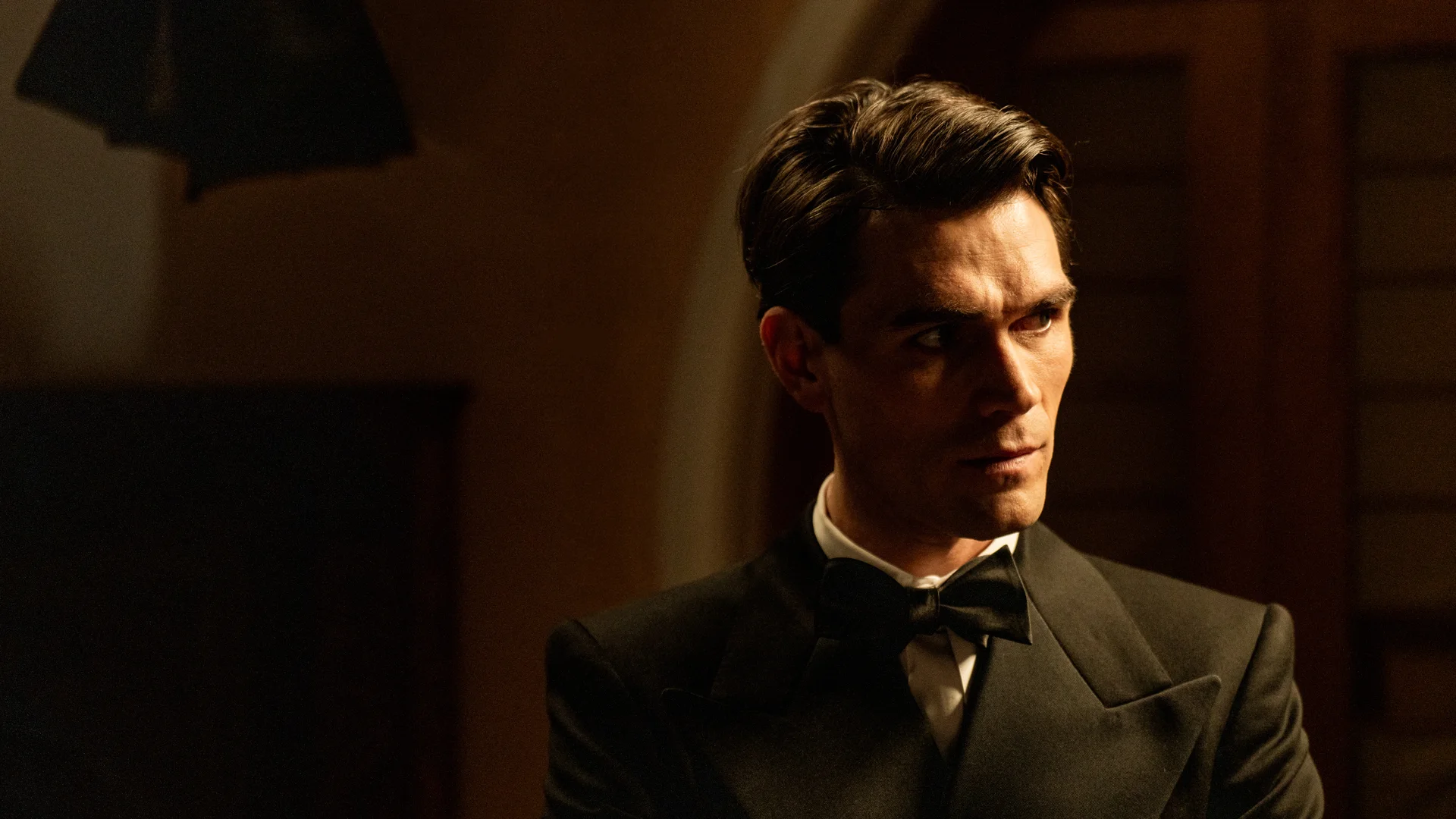
KJ Apa as Jimmy Stewart at the Oscars party in JIMMY.
JIMMY

JIMMY — The Movie: Before a
wonderful life.

You know George Bailey.
Meet the man who came home to play him.

KJ APA AS JIMMY STEWARTAARON BURNS / DIRECTORSCROLL TO DISCOVER
US cinema release
Ireland · Cork screeningMTU Cork School of MusicBuy Cork tickets ↗
Wider Irish cinema releaseAwaiting confirmationOfficial release updates ↗

The life behind the familiar face

The Hollywood star.
The combat pilot.
The journey home.

We remember the face at the window in It’s a Wonderful Life. JIMMY turns towards the life that came before it.

KJ Apa plays Jimmy Stewart in Aaron Burns’s 2026 film, written by Justin Strawhand and filmed in West Cork, Ireland. Explore the real history, the people making the film, and the craft behind its world.

The film
JIMMY (2026)
Leading role
KJ Apa as Jimmy Stewart
Filmed in
West Cork, Ireland
US cinemas
6 November 2026
Cork screening
21 November 2026 · 8:15pm
MTU Cork School of Music
US rating
PG-13

In Ireland, JIMMY screens at MTU Cork School of Music on Saturday 21 November 2026 at 8:15pm (Cork screening details ↗). A wider Irish cinema release date is awaiting confirmation. The videos and photographs below are official promotional material; this feature does not host the full film.

01 / One life. Four chapters.

A familiar name.
An extraordinary journey.

Move through the turning points
behind the new film.

KJ Apa as Jimmy Stewart at the Oscars party in JIMMY.

Chapter one / Hollywood

The world
knew his name.

In 1941, James Stewart won the Best Actor Oscar for The Philadelphia Story.

That same year, he entered military service. JIMMY follows a man whose life was about to move far beyond the screen.

The Academy’s 1941 record ↗
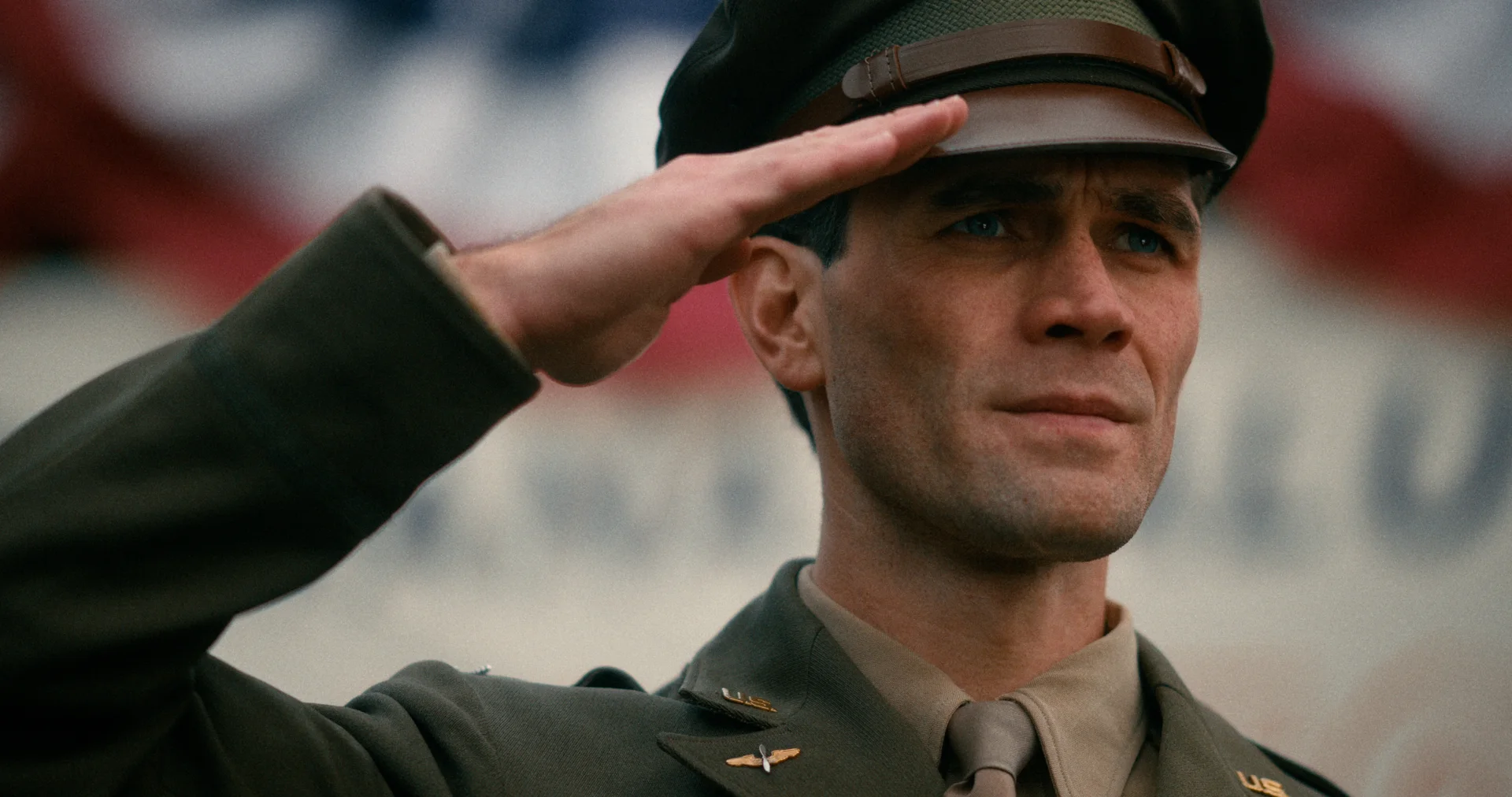
KJ Apa as Colonel Jimmy Stewart in JIMMY.

Chapter two / Wartime service

Another uniform.
Another life.

Stewart became a combat pilot and flew missions over Europe. By the war’s end, he held the rank of colonel.

JIMMY follows that change in direction and the difficult return that followed. The person behind the famous face becomes the centre of the story.

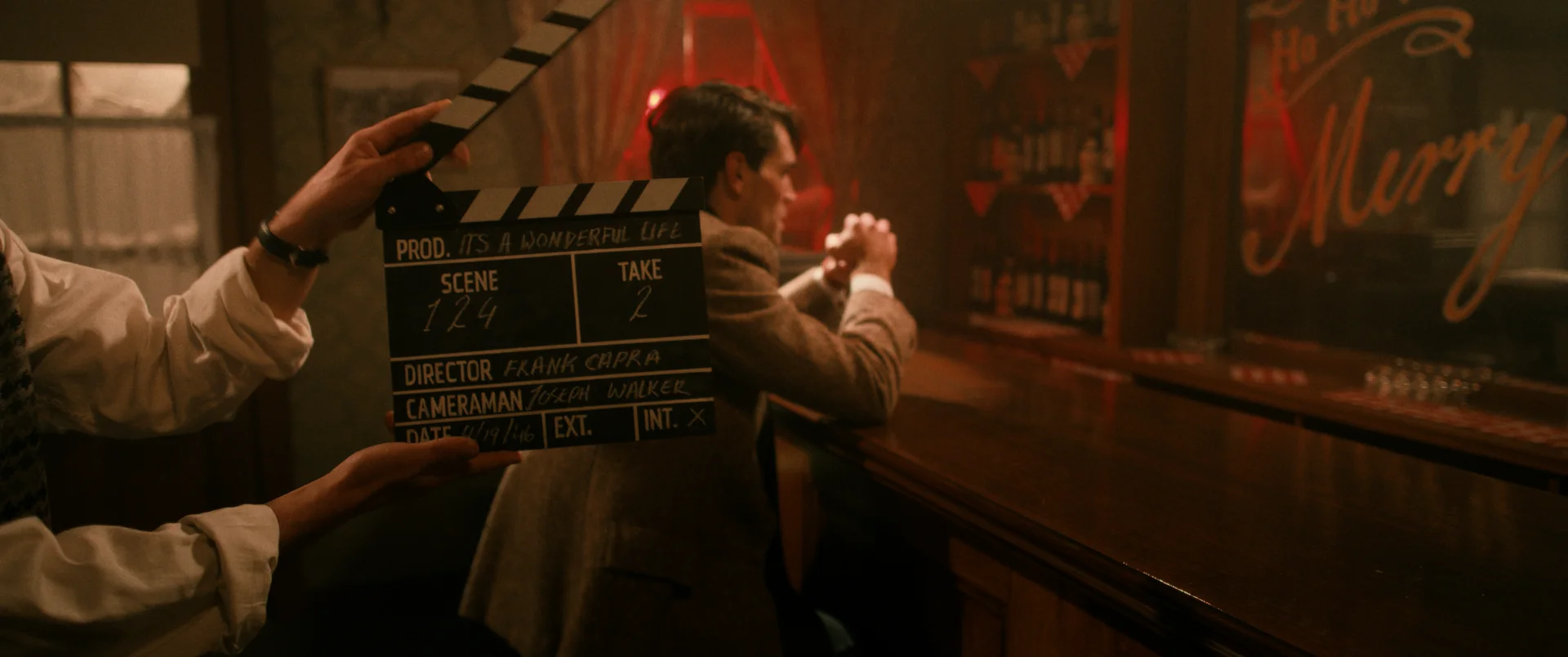
KJ Apa on the recreated It's a Wonderful Life set in JIMMY.

Chapter three / The return

Then came
George Bailey.

It’s a Wonderful Life was Stewart’s first film after four years of military service. It reached the screen in 1946.

We know the story of George Bailey finding his way back. JIMMY asks us to look at the man who came home to play him.

The AFI film record ↗
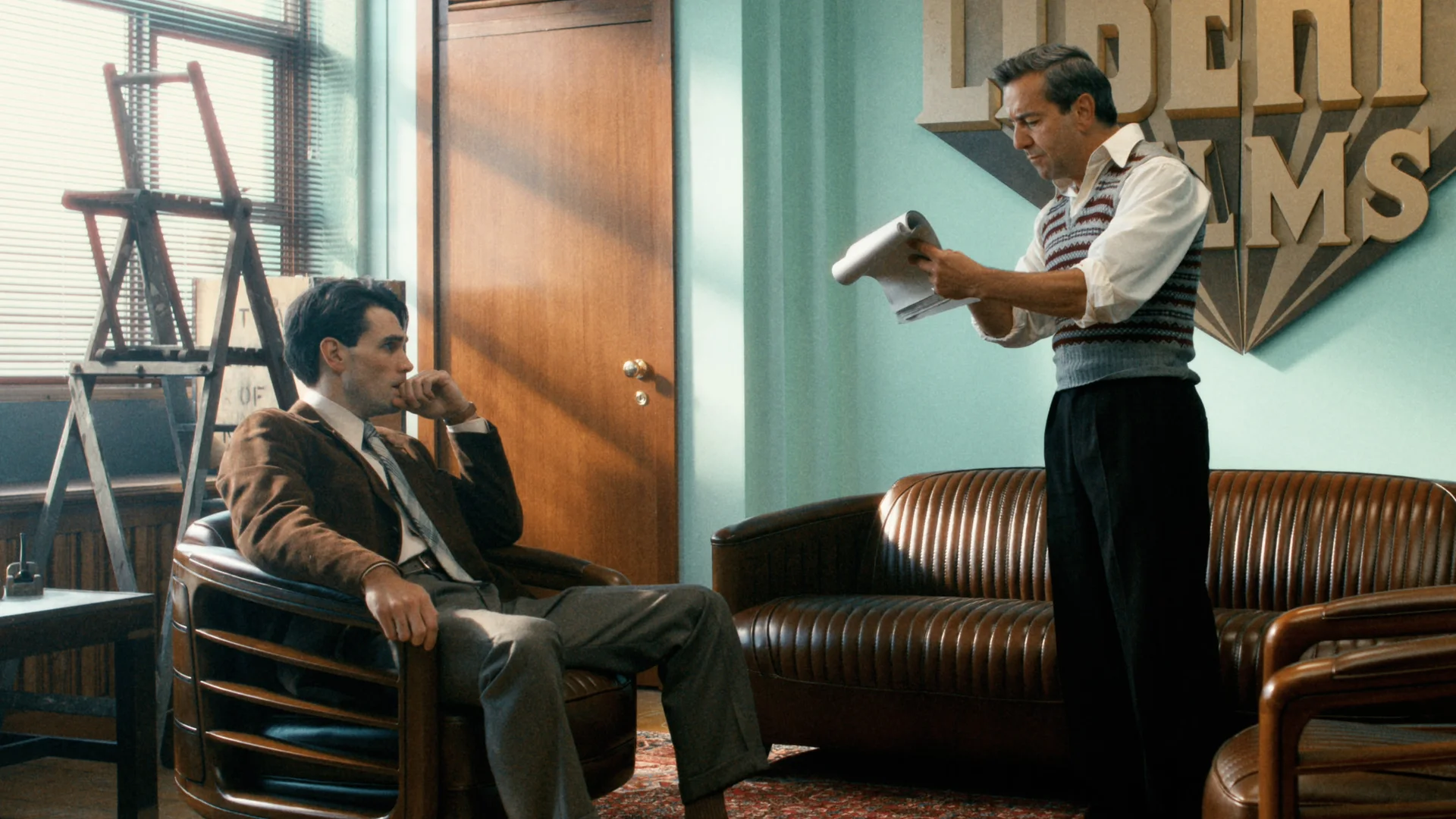
KJ Apa as Jimmy Stewart and Max Casella as Frank Capra in JIMMY.

Chapter four / A new film

A life becomes
a film.

Aaron Burns directs. Justin Strawhand writes. KJ Apa takes on the central role, with Kelly Stewart Harcourt, Stewart’s daughter, among the executive producers.

The US theatrical release is 6 November 2026. Its route to the screen passes through West Cork.

Step onto that set

Chapter images are from the new film, not historical archive photographs.

A film star becoming a squadron commander. A returning serviceman becoming George Bailey. An Irish production bringing both worlds back to life. These are the connections at the heart of JIMMY.

The real life / Hollywood

The Oscar came before the uniform.

Before George Bailey, there was Jefferson Smith. Stewart’s performance in Frank Capra’s Mr. Smith Goes to Washington earned an acting nomination at the 1940 Academy Awards. A year later, he won for The Philadelphia Story. These were different performances: the idealist confronting power and the reporter caught in a romantic comedy. By 1941, Hollywood had already found more than one use for his familiar voice and unassuming presence.

Military service interrupted that career in the same year as his Oscar win. The change is the starting point for JIMMY, directed by Aaron Burns and written by Justin Strawhand. It concentrates on the years linking screen success, combat flying and the return to acting. For a viewer who knows Stewart mainly from a Christmas favourite, that chronology makes the familiar face less simple: George Bailey arrived after a substantial life away from filmmaking.

Sources: Academy record ↗ · Academy record ↗ · Official film site ↗ · Museum account ↗

The real life / Wartime service

A famous name still had to do the flying.

Stewart already had experience as a private pilot. In 1943, he went to England, where his service included flying B-24 Liberators with the 445th Bombardment Group. The National Museum of the Mighty Eighth Air Force records twenty missions over Europe in 1943–44, followed by work with the 453rd Bomb Group. He returned in 1945 as a colonel. The celebrity and the officer were the same person, but responsibility for an aircraft and its crew was a different kind of work from leading a film.

That museum also helped the new production research the period, opening its archives and contributing expertise. Historical photographs, records and firsthand accounts gave the filmmakers material beyond Stewart’s screen image. JIMMY explores the return from those experiences as an emotional journey; the service record supplies the real events that the drama is built around.

Sources: Museum account ↗ · Official film site ↗

The real life / Back in front of the camera

George Bailey followed four years away.

It’s a Wonderful Life was Stewart’s first film after four years of military service. Frank Capra had also returned from wartime work, and the film became the first production of Liberty Films, the company Capra established with William Wyler, George Stevens and Samuel J. Briskin. Its release in December 1946 brought two returning filmmakers together around a story about a man struggling to see the value of his own life.

The Christmas classic was not instantly the institution we know. AFI’s history records favourable reviews and five Oscar nominations, alongside financial results that fell short of expectations. Repeated television screenings helped it find a larger place in popular memory decades later. JIMMY looks back from that familiar destination towards the person who reached it. The connection gives the new film its central question: what happened to Stewart between winning an Oscar and standing in Capra’s camera frame again?

Sources: AFI film history ↗ · Official film site ↗

A life, then a film

The first four dates belong to Stewart’s life. The final two belong to the new production.

  1. 1940

    An acting nomination

    Stewart is nominated at the Academy Awards for the 1939 film Mr. Smith Goes to Washington.

  2. 1941

    An Oscar, then military service

    He wins for The Philadelphia Story and enters military service that year.

  3. 1943–45

    Service in Europe

    Stewart flies with the Eighth Air Force and returns home in 1945 as a colonel.

  4. 1946

    George Bailey

    It’s a Wonderful Life reaches cinemas in December, Stewart’s first film after his wartime service.

  5. 2025

    An Irish production

    Principal photography on JIMMY begins in West Cork on 1 September.

  6. 2026

    JIMMY reaches audiences

    The United States theatrical release begins on 6 November. In Ireland, it screens at MTU Cork School of Music on 21 November 2026 at 8:15pm.

02 / Hear the story. Meet the film.

Take a seat.
There’s more to see.

Open the trailer page

Official trailers and story videos from Burns & Co. The selected video opens in a player here on CastMe.

03 / The Irish chapter

A Hollywood story.
Built in West Cork.

Skibbereen. Castletownsend. Glandore.
A place becomes part of a film.

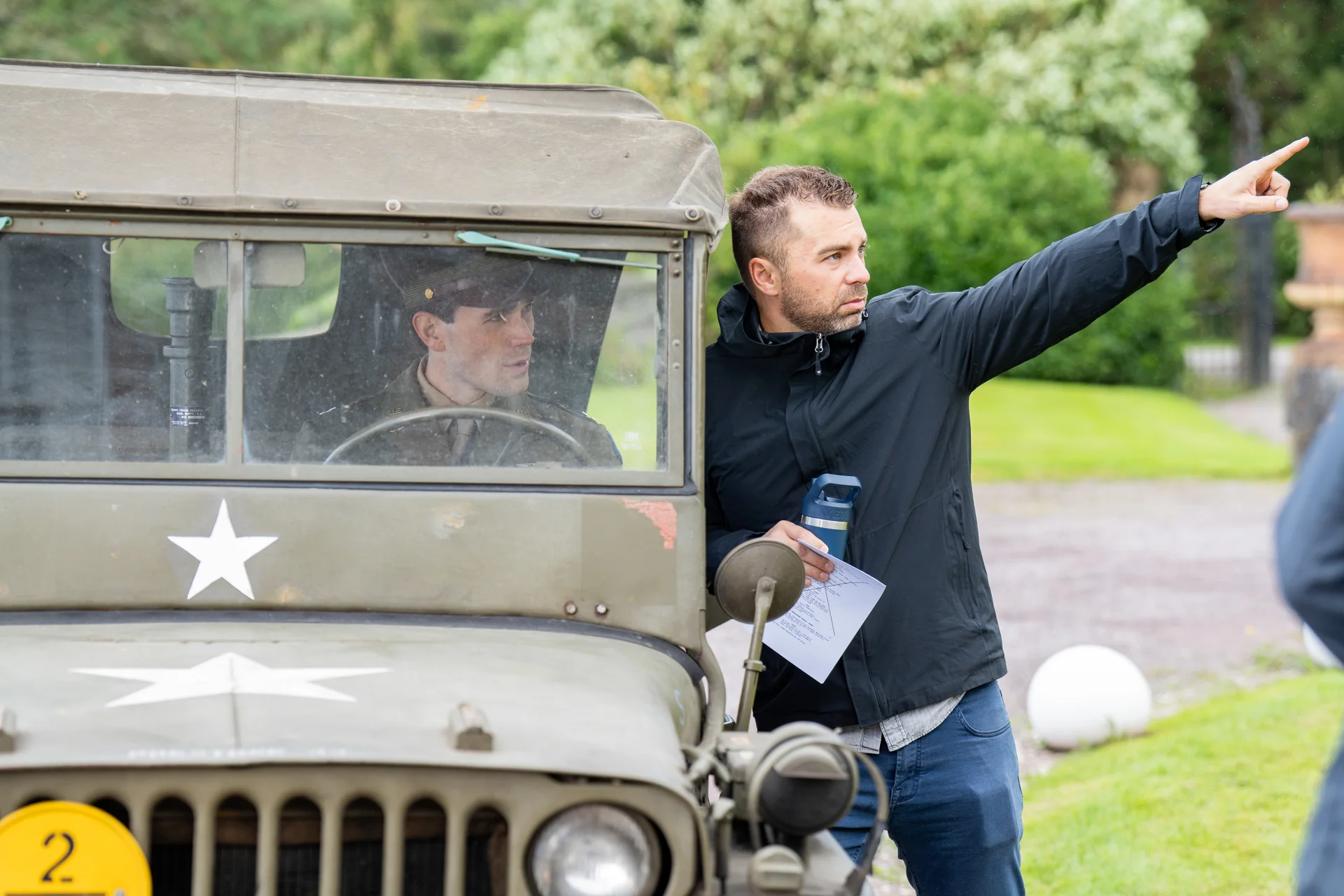
KJ Apa and director Aaron Burns on the set of JIMMY.
Director Aaron Burns with KJ Apa on set. Photograph by Andrew McPherson.

Before a world can appear on screen,
people have to make it.

Filming began at West Cork Studios in Skibbereen on 1 September 2025, with further locations in Castletownsend and Glandore.

Costume, construction, design and the people stepping into the frame helped create Stewart’s world. The official production notes describe a life-size B-24 Liberator replica built on site. They also record a Percival Pembroke used as a wartime-aircraft stand-in at the Skibbereen showgrounds: two distinct aircraft details in the production account.

Read Seán’s first day as an extra
1,000+extras took part
7 tonnesmilitary costumes imported
B-24a full-size replica built on site

Details from the official production notes ↗

Some of the people who made that world

Cinematography
James Mather
Production design
Paki Smith
Costume
Emma O’Loughlin
Makeup
Niamh O’Loan
Hair
Jennie Readman

The new film / Made in Ireland

West Cork had to become more than one world.

Filming began at West Cork Studios in Skibbereen on 1 September 2025. Castletownsend and Glandore also supplied locations. The production’s own account describes more than 1,000 extras, seven tonnes of military costumes brought from the United States and a full-size B-24 replica constructed on site. The same region had to support Hollywood parties, military environments and the people moving through both.

Those numbers describe work as well as scale. Background performers became dancers, medics, townspeople and airbase personnel. Paki Smith’s production design, Emma O’Loughlin’s costumes, James Mather’s cinematography, and the hair and makeup teams led by Jennie Readman and Niamh O’Loan helped connect the different settings. A uniform, a room and a crowd all contribute to where a character belongs. For Irish audiences, this is a concrete local connection to JIMMY: places and people in West Cork helped create the world that international audiences will see.

Some details tie the film to the place itself. At the Skibbereen showgrounds, a Percival Pembroke aircraft stood in for the wartime planes in Stewart’s story. The filmmakers then found a real coincidence: in 1944, a British Halifax bomber had made an emergency landing nearby. A group of U.S. Army and Air Force veterans also flew to Ireland to play wartime officers in one scene.

For the extras, the production notes describe early-morning coach trips, long sessions in 1940s hair and costume, dance rehearsals and a strong sense of camaraderie. The production calls JIMMY the biggest film ever shot in the region, and Aaron Burns says filming in Ireland gave it “the feel of England in the 1940s”.

The town kept the crew going, too. Burns told the Irish Examiner that the team “ate way too many pastries from Fields Bakery”, the bakery behind Skibbereen’s Fields SuperValu. He also praised the welcome from local shops and restaurants, naming The Fish Basket and The Church Restaurant.

Sources: Production material ↗ · Irish Examiner interview ↗ · Fields SuperValu ↗

04 / Across generations

The past is closer
than it seems.

The production account describes KJ Apa studying recordings, biographies and interviews while preparing to play Stewart. He also spoke extensively with Kelly Stewart Harcourt, Stewart’s daughter and an executive producer on JIMMY. Her connection adds a family perspective to the public record. Karolyn Grimes, who played Zuzu in It’s a Wonderful Life, makes a cameo in the new film, bringing a second link to the original production.

For Kelly Stewart Harcourt, the film is personal. She has said her father was proudest of his military service, a part of his life he always kept separate from his films, and that she believes he would approve of JIMMY because its story is true to what that service meant to him. She has been part of the project since it was first announced in February 2024. Visiting the set in Ireland, she was struck by “the communal feelings of pride and cooperation and real happiness”. “I felt Dad’s presence there,” she said. “It was magical.”

Her own working life took her a long way from Hollywood. She grew up in Los Angeles with her twin sister, and a family safari in East Africa when she was 14 began a lifelong love of wildlife. After studying anthropology at Stanford, she spent years in Rwanda in the 1970s and 1980s studying mountain gorillas at Dian Fossey’s research centre, where she met her husband, Sandy Harcourt. She earned a PhD in zoology at Cambridge, later worked at the University of California, Davis, and is still involved in gorilla conservation.

Sources: Production material ↗ · Her biography ↗ · TheWrap ↗

The screenplay also makes deliberate choices about how to tell a life. Kara Killmer’s Lady Julia combines several romantic relationships rather than representing one historical woman. Julian Works’s Lieutenant Martinez is also a composite, used to portray Stewart’s relationship with his co-pilot and crew. Understanding those choices makes the cast more interesting than a list of names: some performers portray documented people; others help the filmmakers gather several experiences into one dramatic relationship.

A familiar film.
A new generation carrying the story.

The museum’s account of the production ↗
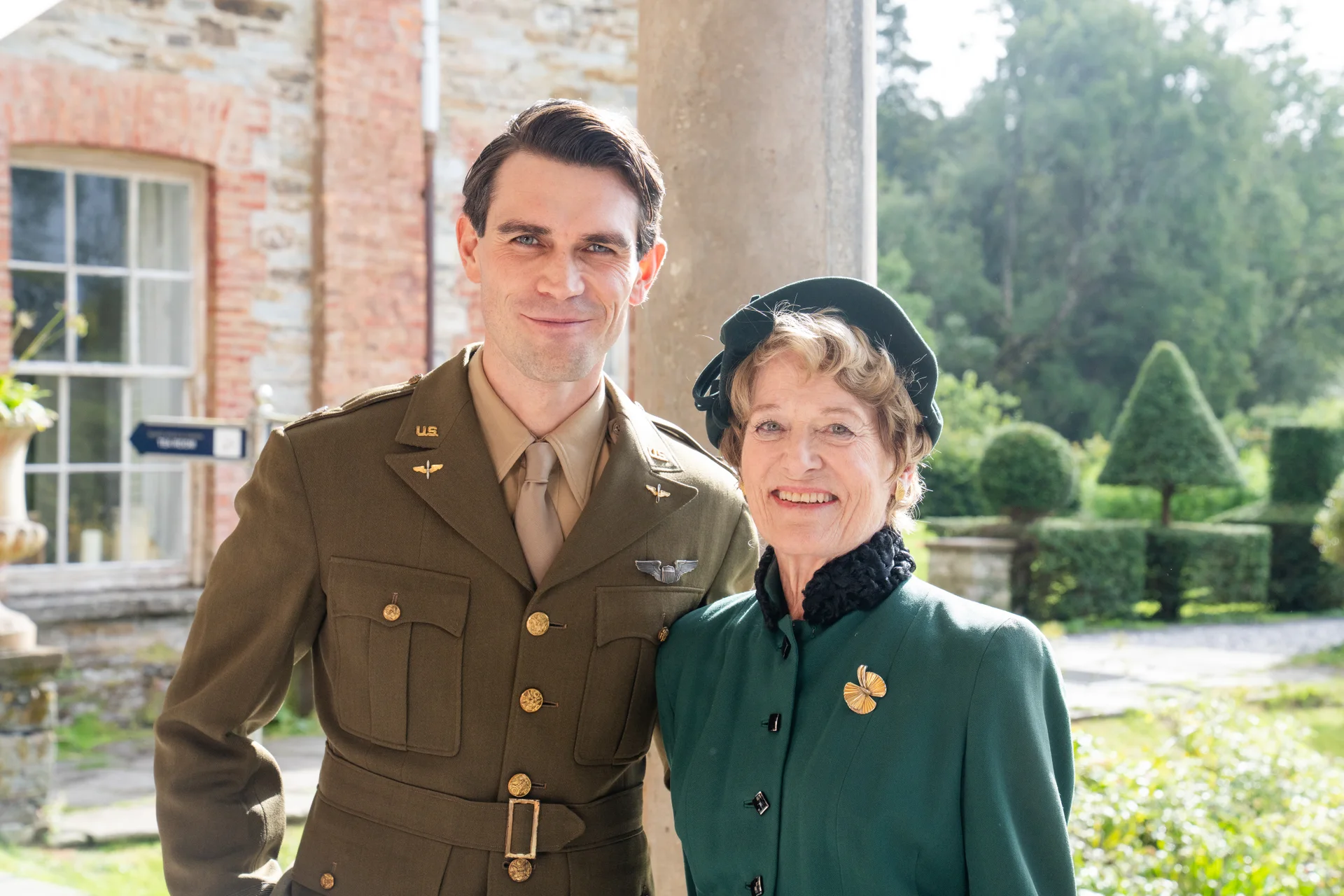
Kelly Stewart Harcourt, Jimmy Stewart's daughter, with KJ Apa on the set of JIMMY.
Kelly Stewart Harcourt and KJ Apa on set.
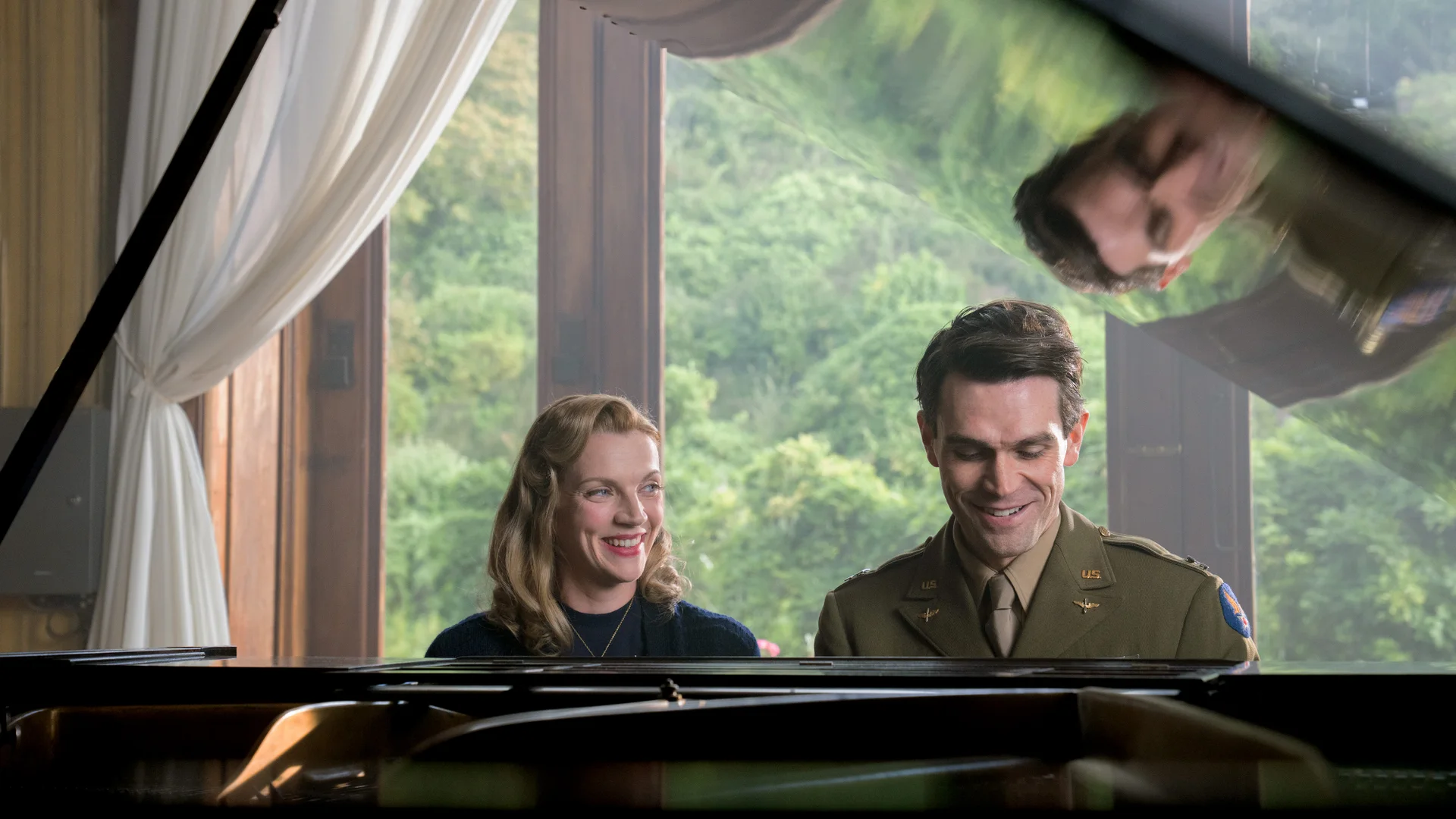
KJ Apa as Jimmy Stewart and Kara Killmer as Lady Julia in JIMMY.

The new film / Music

The sound of home comes from several places.

JIMMY brings together an original score, a contemporary song and music associated with the 1940s. Grant Fonda composed the score. MŌRIAH sings Home to Me, written by Natalie Layne and Bernie Herms. The U.S. Air Forces in Europe Band appears as the Glenn Miller Band and contributed soundtrack recordings. Those are distinct contributions: writing music for the drama, giving its theme a song, and placing performers within the period world.

For an audience, music can move a story between the public and the personal. A band belongs to a place and an occasion; a score can follow what a character cannot explain. The production notes connect these choices to Stewart’s journey away and back. Listening to the official videos offers another way into JIMMY: alongside the recognisable face, pay attention to the different kinds of music carrying the story towards home.

Sources: Production material ↗ · Official film site ↗

06 / A way into filmmaking

Behind
the frame.

Meet a department. Explore a creative choice.
Watch the film’s world a little differently.

Why does a close-up feel different? What makes a room belong to the 1940s? Five crafts, five ways to see more in JIMMY. Choose one, explore a perspective and bring that eye back to the trailer.

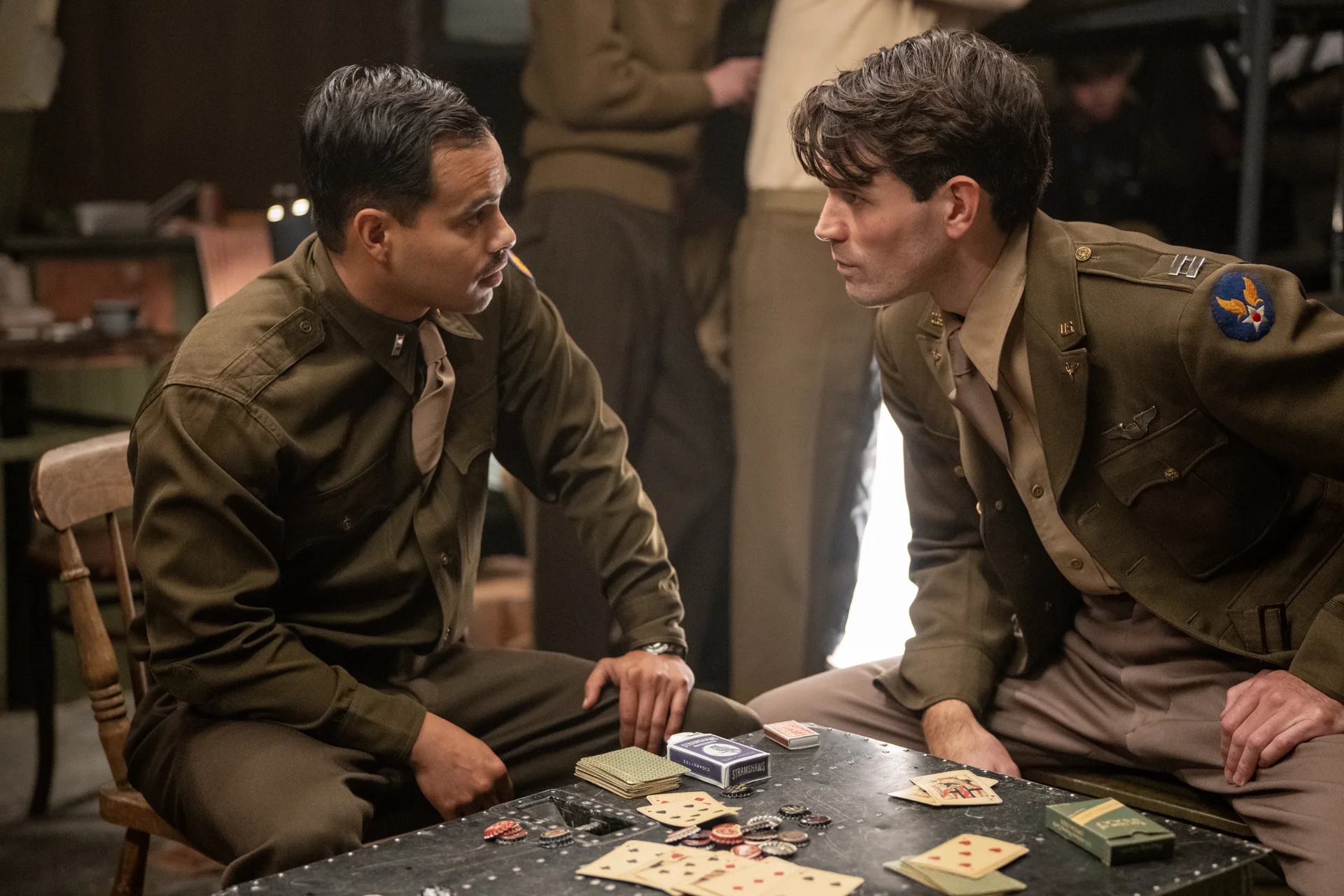
KJ Apa as Captain Jimmy Stewart and Julian Works as Lieutenant Martinez in JIMMY.
Photo courtesy of Burns & Co., © 2026 JIMMY The Movie LLC, All Rights Reserved.

What would you want an audience to notice first?

A way to think about it

The people together

The wider view lets you read relationships: who occupies the room, who faces whom and how the table divides the space. In a moving scene, a wide shot can make an exchange feel like shared activity rather than one person’s isolated experience.

A way to think about it

One person’s response

Moving closer puts more weight on a face and less on the surroundings. A small reaction may become the event. Notice what you lose as well: less of the other people’s body language and less information about the room.

A way to think about it

The world around them

Giving the room more visual weight makes its surfaces, furniture and arrangement easier to read. That can establish a workplace or period, but it can also make a person feel small within an institution. Framing is a decision about attention, not simply a closer or wider picture.

Cinematography / James Mather

Change the frame. Change what you notice.

James Mather is JIMMY’s director of photography. The production notes describe a visual journey between the public world of Hollywood and Stewart’s more private experience of war and returning home.

Try framing this official production photograph three ways. The people, the table and the room stay the same. Your attention doesn’t. This is a framing exercise, not a reconstruction of Mather’s shots in the finished film.

Sources: Production material ↗

KJ Apa as Jimmy Stewart and Max Casella as Frank Capra in JIMMY.
Photo courtesy of Burns & Co., © 2026 JIMMY The Movie LLC, All Rights Reserved.

Production design / Paki Smith

A place has to play a part.

Paki Smith led JIMMY’s production design. West Cork supplied several screen worlds, while the official production notes describe a full-size B-24 replica built on site. The notes also identify a Percival Pembroke used as a stand-in at the Skibbereen showgrounds. A location is the starting material; the designed world is what the audience sees.

Look at the official photograph of the recreated film set. Consider the space, objects and people as parts of one designed environment. What makes it feel like a place where work happens, rather than a collection of period objects?

If you had to establish this world with one detail, where would you begin?

A way to think about it

Objects people use

An object handled in a scene has to support the action as well as belong to the period. A chair, document or piece of equipment can tell us what work happens here. Design and props teams turn research into things an actor can actually use.

A way to think about it

How the room works

Entrances, distances and the arrangement of a space shape how people can move and meet. Before choosing decoration, ask what the scene needs people to do. A convincing room should support the story’s action, not only look historical.

A way to think about it

What stays consistent

A film may shoot different parts of one story in several locations and out of sequence. Repeating the right materials, colours and objects helps those pieces belong to the same world. Consistency is often work an audience notices only when it is missing.

Sources: Production material ↗

KJ Apa as Jimmy Stewart at the Oscars party in JIMMY.
Photo courtesy of Burns & Co., © 2026 JIMMY The Movie LLC, All Rights Reserved.

Costume design / Emma O’Loughlin

Before a character speaks, the clothes speak.

Emma O’Loughlin designed JIMMY’s costumes. The production notes describe seven tonnes of military costumes imported from the United States, alongside the clothing needed for Hollywood and civilian life.

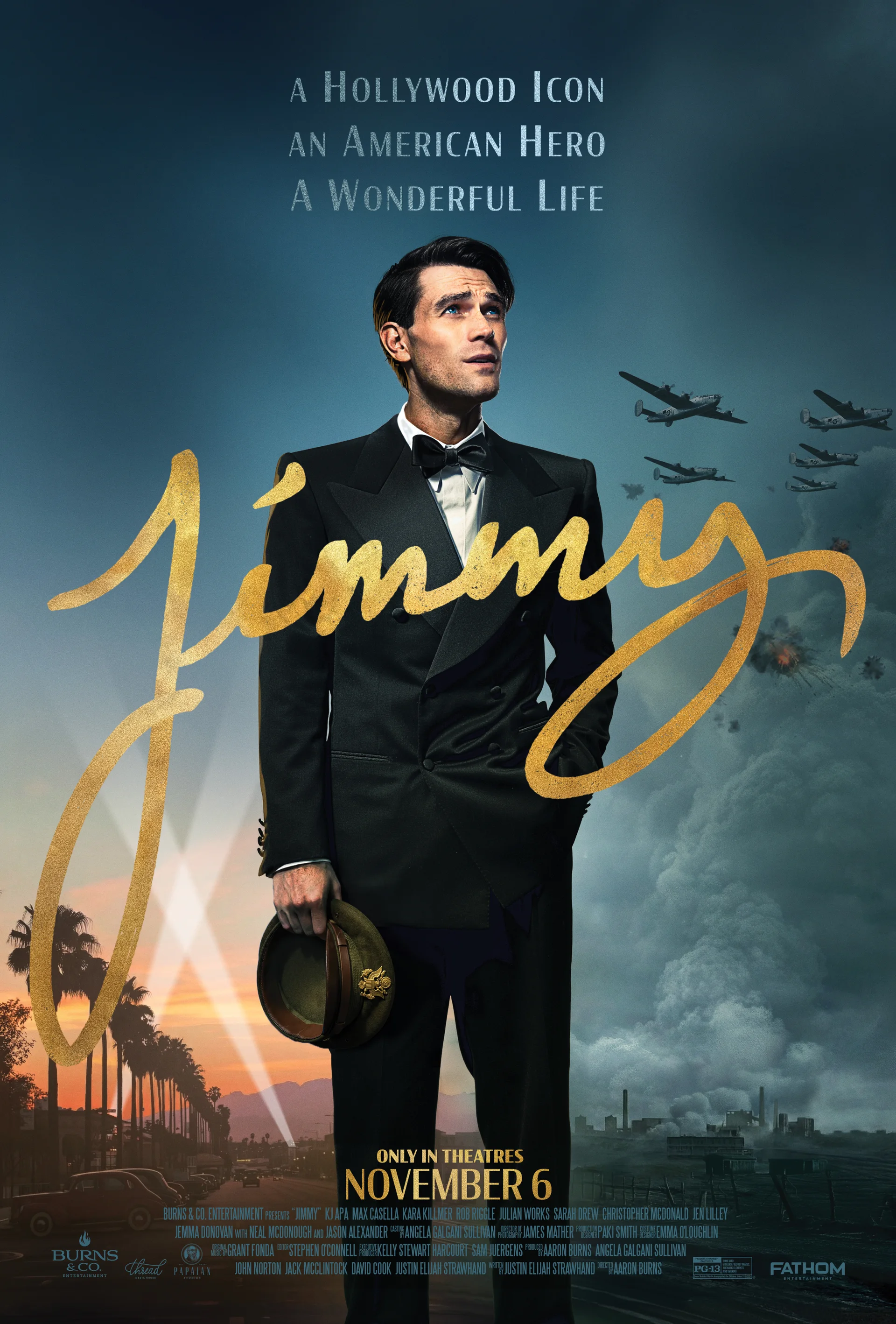
Compare the formal evening wear in this official still with the uniform in the trailer poster. Both belong to Stewart’s story, but they place him in different social worlds. Hair and makeup also help those worlds fit together.

What would you research first for a character moving between these worlds?

A way to think about it

Who they are in this scene

A uniform can identify a person’s role in an organisation; formal wear can express the expectations of a social occasion. The useful first question is not only ‘what year is it?’ but ‘what is expected of this person here?’ Costume can make those expectations visible.

A way to think about it

What their clothes have lived through

Newness, wear, repairs and fit can suggest a life beyond the immediate scene. These are storytelling tools, but historical and practical research still matters. A convincing choice must allow the performer to move and survive repeated filming.

A way to think about it

How the whole crowd belongs

More than 1,000 extras took part, according to the production notes. Background costumes need variation without breaking the shared period and setting. A crowd should feel like people with different lives, not a rack of identical outfits.

Sources: Production material ↗

Kelly Stewart Harcourt, Jimmy Stewart's daughter, with KJ Apa on the set of JIMMY.
Photo courtesy of Burns & Co., © 2026 JIMMY The Movie LLC, All Rights Reserved.

Performance / KJ Apa

Play the person, not only the recognisable voice.

The production account describes Apa studying recordings, biographies and interviews, and speaking with Stewart’s daughter Kelly Stewart Harcourt. Research offered both a public record and a family perspective.

This is a behind-the-scenes photograph of Apa with Harcourt, not a scene from the film. Imagine preparing to portray someone whose family can describe the person beyond their famous performances.

Which kind of research would help you move beyond an impression?

A way to think about it

Watch the public record

Recordings offer observable rhythms, posture and ways of speaking. Distinguish a performer’s on-screen character from their behaviour in interviews: the public record contains more than one version of a person.

A way to think about it

Listen to someone who knew them

A family perspective may describe private habits, relationships and values that a performance archive cannot show. It is one perspective, not a substitute for every other source. Careful preparation compares accounts rather than turning a single anecdote into the whole person.

A way to think about it

Work out what they need now

Research is preparation; a scene still needs an active relationship. Ask what the character wants from the other person in this moment, and what stands in the way. That gives the performance something to do beyond displaying a familiar mannerism.

Sources: Production material ↗

KJ Apa as Jimmy Stewart and Kara Killmer as Lady Julia in JIMMY.
Photo courtesy of Burns & Co., © 2026 JIMMY The Movie LLC, All Rights Reserved.

Music / Grant Fonda · MŌRIAH · U.S. Air Forces in Europe Band

A band, a score and a song do different work.

Grant Fonda composed the original score. MŌRIAH performs Home to Me, written by Natalie Layne and Bernie Herms. The U.S. Air Forces in Europe Band appears as the Glenn Miller Band and contributed soundtrack recordings.

Listen to one of the official videos, then return to this question. Music can establish an occasion, follow a character’s emotions or carry a theme beyond a scene. Listen for what changes when music comes forward, moves into the background or falls away.

What would you want the music to tell the audience?

A way to think about it

Where and when we are

Music performed by people within a scene can belong to its world: a band at an occasion, for example. Filmmakers call this diegetic music. Its source is part of the story, even when it also affects the audience emotionally.

A way to think about it

What someone cannot say

A score can accompany a feeling without a character hearing the music. It can connect moments separated by time and place. Listen for changes in intensity, texture and silence rather than assuming louder always means more emotional.

A way to think about it

What the story leaves with us

An original song can give a film’s central theme a different voice. The production connects Home to Me with returning home after change. That is a separate contribution from both the dramatic score and music performed inside the film’s period world.

Sources: Production material ↗

Production facts come from the film’s published materials. The learning observations are an interpretation, not a record of unreported filmmaking decisions.

07 / The people behind the picture

A credit is
a contribution.

Explore the cast, filmmakers and departments.
Find out what their work brings to JIMMY.

The cast and contributors named in the official production notes, fact sheet, poster, biographies and media captions reviewed for this feature. This is a guide to those published credits, not the film's complete end-credit roll.

36 credits

The people on screen

Jimmy Stewart

KJ Apa

The New Zealand actor, known for playing Archie Andrews in Riverdale, leads JIMMY through Stewart's Hollywood success, military service and return to acting. For this performance, Apa studied archival film, biographies and interviews, and spoke extensively with Stewart's daughter, Kelly Stewart Harcourt.

What this contribution means

The lead actor carries the central character's journey through performance, voice, movement and interactions with the ensemble.

Sources: Production material ↗ · Production material ↗

Frank Capra

Max Casella

Casella plays the filmmaker whose work with Stewart includes Mr. Smith Goes to Washington and It's a Wonderful Life. His own screen career ranges from Doogie Howser, M.D. and Tulsa King to Inside Llewyn Davis and Ed Wood; he also originated Timon in Broadway's The Lion King.

What this contribution means

A supporting actor develops a character whose relationship with the protagonist helps reveal the story's choices and turning points.

Sources: Production material ↗ · Production material ↗

Lady Julia Tyndall; vocal performance of I'll Be Home for Christmas

Kara Killmer

Known for Sylvie Brett in Chicago Fire, Killmer plays Lady Julia, a composite of women and romantic relationships in Stewart's life before his marriage. The character explores the distance between his public image and private life. Killmer also performs I'll Be Home for Christmas in the film.

What this contribution means

A composite character brings elements of several real people into one dramatic figure; Lady Julia is not presented as one documented historical person.

Sources: Production material ↗ · Production material ↗ · Production material ↗

Second Lieutenant Martinez

Julian Works

Works plays Stewart's co-pilot and second-in-command through Martinez, a composite character that helps show his relationship with changing wartime crews. Previously, Works played Mateo Chavez in 9-1-1: Lone Star and Joe Trevino in The Long Game, a drama about Mexican-American golfers in 1950s Texas.

What this contribution means

A composite character can make a changing group of historical relationships understandable without claiming that one person experienced every depicted event.

Sources: Production material ↗ · Production material ↗

Hedda Hopper

Sarah Drew

Drew portrays the Hollywood columnist whose relationship with Stewart linked career-making publicity with intense interest in his private life. Known for April Kepner in Grey's Anatomy and Hannah in Everwood, Drew also stars in and executive produces Mistletoe Murders, alongside her work as a writer and director.

What this contribution means

Portraying a historical figure means shaping a dramatic performance from the script and research, rather than treating every scene as documentary footage.

Sources: Production material ↗ · Production material ↗

Lieutenant Colonel Robert H. Terrill

Rob Riggle

Riggle portrays the commander who recognised Stewart's leadership and entrusted him with a bombardment squadron. Alongside screen work including Step Brothers and The Hangover, and appearances on Saturday Night Live and The Daily Show, Riggle served in the U.S. Marine Corps and retired as a lieutenant colonel.

What this contribution means

This supporting performance represents the military authority whose trust gives Stewart the chance to lead, rather than remain a celebrity recruiting figure.

Sources: Production material ↗ · Production material ↗

Lionel Barrymore

Christopher McDonald

McDonald plays the veteran actor who worked with Stewart on It's a Wonderful Life and encouraged him to see value in acting after the war. His own credits include Happy Gilmore, Thelma & Louise, Quiz Show and Hacks, spanning comedy, drama and the studio-era world JIMMY revisits.

What this contribution means

A supporting character can give the protagonist a different perspective; here Barrymore connects Stewart's return to acting with its value to audiences.

Sources: Production material ↗ · Production material ↗

Gloria Stewart

Jen Lilley

Lilley portrays Gloria, whose marriage to Stewart marked his transition from Hollywood's celebrated bachelor to husband and father. Lilley's own work includes Days of Our Lives, General Hospital and The Artist. She is also a singer and producer, and founded the film funding and marketing platform Raise the Reel.

What this contribution means

The performance gives the central character's family life a presence on screen, rather than leaving that part of the story in narration.

Sources: Production material ↗ · Production material ↗

Ginger Rogers

Jemma Donovan

Donovan plays Ginger Rogers, part of the young Stewart's Hollywood world before military service. She made her professional screen debut in the BBC adaptation of Mr Stink and later appeared in Neighbours and Hollyoaks. Her work also includes the stage production Closure at Theatre Royal Windsor.

What this contribution means

An ensemble performance helps establish the people and social world around the lead, even when the character appears in a smaller part of the film.

Sources: Production material ↗ · Production material ↗ · Production material ↗

Susannah; special cameo

Karolyn Grimes

Grimes played Zuzu Bailey opposite Jimmy Stewart in the original It's a Wonderful Life. Her cameo in JIMMY creates a direct connection between the new film and Capra's 1946 production. The production notes also recall her friendship with Stewart, which continued after they reconnected when she was an adult.

What this contribution means

A cameo is a brief appearance; its significance can come from the performer's connection to the subject as well as the character they play.

Sources: Production material ↗ · Production material ↗

Alexander Stewart

Neal McDonough

McDonough plays Jimmy's father, a hardware-store owner whose own military service helped shape his son's sense of responsibility. Known for Band of Brothers, Yellowstone and Tulsa King, McDonough also works behind the camera: he and Ruvé McDonough are executive producers of JIMMY.

What this contribution means

This supporting role gives the story's family influence a dramatic presence; the actor's producing credit is a separate contribution behind the camera.

Sources: Production material ↗ · Production material ↗

Louis B. Mayer

Jason Alexander

Alexander plays the MGM studio chief, representing the system Stewart had to leave behind when he chose military service. Widely known for Seinfeld, Alexander's work also extends to directing for television, film and theatre, including the features For Better or Worse and Just Looking, and Broadway's The Cottage.

What this contribution means

The actor embodies the studio authority in the story; portraying a director or executive on screen is distinct from doing that job on this production.

Sources: Production material ↗ · Production material ↗

Glenn Miller

Marc Malkin

The official production gallery identifies Malkin as Glenn Miller in a scene with Kara Killmer and the U.S. Air Forces in Europe Band. The real military ensemble portrays Miller's band in JIMMY, bringing performing musicians into the recreation rather than relying on actors alone.

What this contribution means

The character performance places the bandleader within the scene; the accompanying musicians' playing is a separate musical contribution.

Sources: Official film site ↗ · Source ↗ · Production material ↗

The people who brought it together

Director and producer

Aaron Burns

Burns directs JIMMY and is one of its producers through Burns & Co. Entertainment, the company he founded. His earlier directing work includes Birthright Outlaw and Legacy Peak; his producing credits include Beyond the Mask, War Room and The Forge. JIMMY focuses on a pivotal chapter rather than Stewart's entire life.

What this contribution means

The director shapes performances and the film's creative approach. A producer helps organise the people, resources and decisions needed to make it.

Sources: Production material ↗ · Production material ↗

Writer and producer

Justin Strawhand

Strawhand wrote JIMMY's screenplay and is credited as a producer. The official poster uses his full credit name, Justin Elijah Strawhand. His background spans documentaries, westerns and live international sports television, and he serves as Head of Story at Burns & Co. Entertainment.

What this contribution means

The screenwriter turns research and story ideas into scenes, dialogue and a dramatic structure; a producing credit recognises a separate production contribution.

Sources: Production material ↗ · Production material ↗ · Source ↗

Producer, casting director and chief marketing officer

Angela Galgani Sullivan

Sullivan's official JIMMY biography identifies three connected responsibilities: producing the film, overseeing its casting and leading its marketing campaign. Her background includes more than two decades in publicity and promotions at Sony Pictures, followed by work with Sony-owned Pure Flix. The poster separately credits her casting work.

What this contribution means

Casting finds performers for the roles. Marketing connects the finished film with audiences. Producing supports the wider process of getting it made.

Sources: Production material ↗ · Source ↗

Producer

David Cook

Cook is one of JIMMY's six producers named in the official production notes. His earlier career began in radio and television in Spain before moving into U.S. feature production with Advent Film Group. An official festival biography records work in various capacities on films including Beyond the Mask, War Room and Overcomer.

What this contribution means

Producers help make a film possible and keep it moving through development, financing, production and completion; responsibilities differ across a producing team.

Sources: Production material ↗ · Source ↗

Producer

John Norton

Norton is a JIMMY producer and Head of Production at Ireland's RedTed Media. His company's profile describes two decades of international co-production work and support for first-time feature directors, including King Frankie and The Ritual. His recent producing slate also includes The Body is Water.

What this contribution means

A producer working across countries helps coordinate a production's creative needs with local crews, locations, resources and practical delivery.

Sources: Production material ↗ · Source ↗

Producer

Jack McClintock

McClintock is named as a JIMMY producer in the current official notes and poster. He founded the video company that became GP Creative, which now works across video and design. His documentary work also includes an executive-producing role on ESL: More Than a Language through Thread Media House.

What this contribution means

A producer supports the film as a whole rather than one craft department, bringing together the relationships and resources needed to deliver it.

Sources: Production material ↗ · Source ↗ · Source ↗ · Source ↗ · Source ↗

Executive producer

Kelly Stewart Harcourt

Stewart's daughter is an executive producer and an important connection to the man behind the public image. She spoke extensively with KJ Apa and visited the Irish set. Outside film, Stewart Harcourt's career is in zoology and anthropology: she studied mountain gorillas in Rwanda at Dian Fossey's research centre, earned a PhD in zoology at Cambridge and taught at the University of California, Davis.

What this contribution means

An executive producer may support a film through development, relationships, rights, funding or oversight; the precise contribution varies by production.

Sources: Production material ↗ · Production material ↗ · Source ↗

Executive producer

Sam Juergens

The official poster credits Juergens as an executive producer. When the project was first announced in February 2024, under the working title A Truly Wonderful Life, he was named as a co-producer alongside Aaron Burns. The released film's writing credit belongs to Justin Elijah Strawhand, as shown on that poster.

What this contribution means

An executive producer may support a film through development, relationships, rights, funding or oversight; involvement can begin years before filming.

Sources: Source ↗ · TheWrap ↗

Executive producer

Neal McDonough

McDonough contributes both on screen, as Alexander Stewart, and behind the camera. His official JIMMY biography confirms that he executive produced the film alongside Ruvé McDonough. Their wider producing work includes The Warrant, Boon, The Shift and Homestead, bringing a continuing production partnership to this project.

What this contribution means

An actor can also be an executive producer; the producing credit is separate from their performance and does not mean they directed the film.

Sources: Production material ↗

Executive producer

Ruvé McDonough

The film's official biography of Neal McDonough names Ruvé as his fellow executive producer on JIMMY. The same source describes their continuing producing partnership across projects including The Warrant, Boon, The Shift and Homestead. Her contribution here is a production credit, not an on-screen role.

What this contribution means

An executive producer supports the project at a broader production level; this credit alone does not identify a specific day-to-day department job.

Sources: Production material ↗

The people who built its world

Director of photography

James Mather

Mather is responsible for JIMMY's cinematography. The production notes describe a visual approach that moves between polished Hollywood settings, military life and Stewart's changed experience of home. His work brings together the scale of a period production and the intimacy of the central performance.

What this contribution means

The director of photography leads the camera and lighting approach, working with the director to turn scenes into images.

Sources: Production material ↗ · Source ↗

Production designer

Paki Smith

Smith designed the physical world of JIMMY, from Hollywood spaces to military environments. His own portfolio places the film alongside production-design work on Small Things Like These, Bodkin, The Man Who Invented Christmas and Viva. The challenge here was making the 1940s feel inhabited, not merely decorated.

What this contribution means

The production designer leads the overall design of sets and screen environments, coordinating their look with locations, props and other departments.

Sources: Production material ↗ · Source ↗

Costume designer

Emma O'Loughlin

O'Loughlin's costumes help distinguish Stewart the Hollywood star from Stewart the military officer, while establishing the wider ensemble's different social worlds. Her representation lists JIMMY alongside costume-design work on Trespasses and Wreck. Her earlier costume-department experience includes the first four seasons of Game of Thrones.

What this contribution means

A costume designer develops the clothing language of the characters, balancing story, period research, fit and the practical demands of filming.

Sources: Production material ↗ · Source ↗

Makeup department lead

Niamh O'Loan

The official notes identify O'Loan as JIMMY's makeup department lead. Her department's work supports the ensemble's period appearance and the changing look of Stewart across Hollywood, military service and his return. The production describes that transformation as part of the character story, not simply cosmetic detail.

What this contribution means

A makeup department creates and maintains characters' makeup looks, coordinating period detail and continuity throughout filming.

Sources: Production material ↗

Head of hair

Jennie Readman

Readman heads JIMMY's hair department, according to the official production notes. Hairstyles and grooming help place the ensemble in the 1940s and support Stewart's changing appearance through the film. Together with costume and makeup, the department helps turn contemporary performers into people belonging to that world.

What this contribution means

The head of hair leads the team responsible for character hairstyles, wigs and grooming, keeping those looks consistent between scenes and filming days.

Sources: Production material ↗

Editor

Stephen O'Connell

O'Connell's editing credit appears on JIMMY's official poster. His earlier work includes Viva, The Pipe and The Sea, and television productions such as Fortitude and The Tunnel. The Irish Film & Television Academy records his 2016 editing nomination for Viva and an earlier IFTA win for Stardust.

What this contribution means

The editor shapes filmed material into the finished story, choosing performances and building scene order, rhythm and emotional transitions with the director.

Sources: Source ↗ · Source ↗

Photographer — official production publicity still

Andrew McPherson

McPherson is credited for the official on-set photograph of KJ Apa with director Aaron Burns. The image gives this feature a view of the performer and filmmaker together during production. It is an official publicity still, rather than an image taken from the finished movie.

What this contribution means

Production still photography documents a film and its making in photographs, distinct from the motion-picture camera work.

Sources: Official film site ↗

Photographer — official production publicity stills

Miki Barlok

The official gallery credits Barlok for photographs including Neal McDonough as Alexander Stewart and Kara Killmer with Marc Malkin and the U.S. Air Forces in Europe Band. These stills provide views of the family and musical worlds recreated for JIMMY, with photographer credits retained in this feature.

What this contribution means

A production photograph preserves a character, scene or behind-the-scenes moment for publicity and editorial use; it is not the film's cinematography.

Sources: Official film site ↗

The people who gave it a sound

Original score composer; new arrangement of Puttin' on the Ritz

Grant Fonda

Fonda composed JIMMY's original score, recording with Los Angeles musicians at Bandrika Studios, and created a new arrangement of Puttin' on the Ritz. His earlier scoring work includes At Midnight, Dating & New York and Exmas. The film's music connects Hollywood, wartime Europe and the return home.

What this contribution means

A score composer writes music to support the film's scenes and emotional structure; an arrangement reworks an existing song for a particular performance.

Sources: Production material ↗ · Production material ↗

Performer of Home to Me

MŌRIAH

MŌRIAH performs JIMMY's original song Home to Me. The Mexican-American artist works in English and Spanish, with the companion releases Nice Life and Buena Vida, and was selected for CMT's 2025 Next Women of Country programme. Her screen work also includes Reagan, Journey to Bethlehem and The Chosen.

What this contribution means

The recording artist gives the song its vocal performance; performing a song is distinct from writing or producing its recording.

Sources: Production material ↗ · Production material ↗

Co-writer of Home to Me

Natalie Layne

Layne co-wrote Home to Me with Bernie Herms, according to JIMMY's official music notes. MŌRIAH performs the resulting original song. Its place in the film connects to Stewart's journey back from wartime service and the question of what returning home means after a life-changing experience.

What this contribution means

A songwriter creates a song's musical and lyrical material. A co-writing credit identifies a shared contribution, separate from the singer's performance.

Sources: Production material ↗

Co-writer and producer of Home to Me

Bernie Herms

Herms co-wrote Home to Me with Natalie Layne and produced the recording performed by MŌRIAH. Those are two separate contributions identified in the official production notes. The original song sits alongside Grant Fonda's score, period standards and military-band performances in JIMMY's musical landscape.

What this contribution means

The songwriter develops the song; the record producer guides how its performance is recorded and shaped into a finished track.

Sources: Production material ↗

Glenn Miller Band on screen; soundtrack performances

U.S. Air Forces in Europe Band

Based at Ramstein in Germany, the military ensemble travelled to the Irish set to portray the Glenn Miller Band. It also recorded three soundtrack songs: I'll Be Home for Christmas, Strike Up the Band and the U.S. Army Air Corps song. Its musicians contribute both on camera and through the recordings.

What this contribution means

An on-screen ensemble can perform within a scene and also contribute music to the soundtrack; these are related but distinct recording and acting tasks.

Sources: Production material ↗ · Production material ↗

Keep exploring

A few things
worth knowing.

Is JIMMY based on a true story?

It draws on Jimmy Stewart’s Hollywood career, military service and return to filmmaking. It is a dramatised film, not a documentary. The official production notes explicitly identify Lady Julia and Lieutenant Martinez as composite characters.

Where was JIMMY filmed in Ireland?

Principal photography began at West Cork Studios in Skibbereen on 1 September 2025. The production notes also name Castletownsend and Glandore among the locations.

Who plays Jimmy Stewart?

KJ Apa plays Stewart. Aaron Burns directs the film, written by Justin Strawhand. Explore the credits above for cast profiles, character context and the departments behind the production.

When can I see JIMMY?

In Ireland, JIMMY screens at MTU Cork School of Music on Saturday 21 November 2026 at 8:15pm. Its US theatrical release begins on 6 November 2026. A wider Irish cinema release date is awaiting confirmation. Follow the official film site for regional release announcements; the US screening link below is labelled by territory.

Is JIMMY suitable for younger viewers?

In the US it is rated PG-13 for war violence, bloody images, thematic elements and smoking. An Irish age rating has not been published.

Can I watch the whole film here?

No. This feature offers the official promotional videos, official photographs, an original editorial story and learning explorations. It does not provide or imply access to the full film.

What is historical, and what is a learning exercise?

The life chronology is sourced to the Academy, AFI and the National Museum of the Mighty Eighth Air Force. Production details come from the filmmakers’ materials. Behind the frame is an educational interpretation; it is not a record of unreported camera decisions or an interview with the departments.

Official JIMMY poster.

The next chapter belongs to the audience

Now meet
JIMMY.

US theatrical release
6 November 2026

Cork screening
21 November 2026 · 8:15pm
MTU Cork School of Music

For release information in your region, visit the official film site.

Back to the beginning ↑

More films

Every film starts
with people.

Explore more film stories

Meet the work, discover the people behind it and find your own way into making.

JIMMY / In pictures

Watch JIMMY